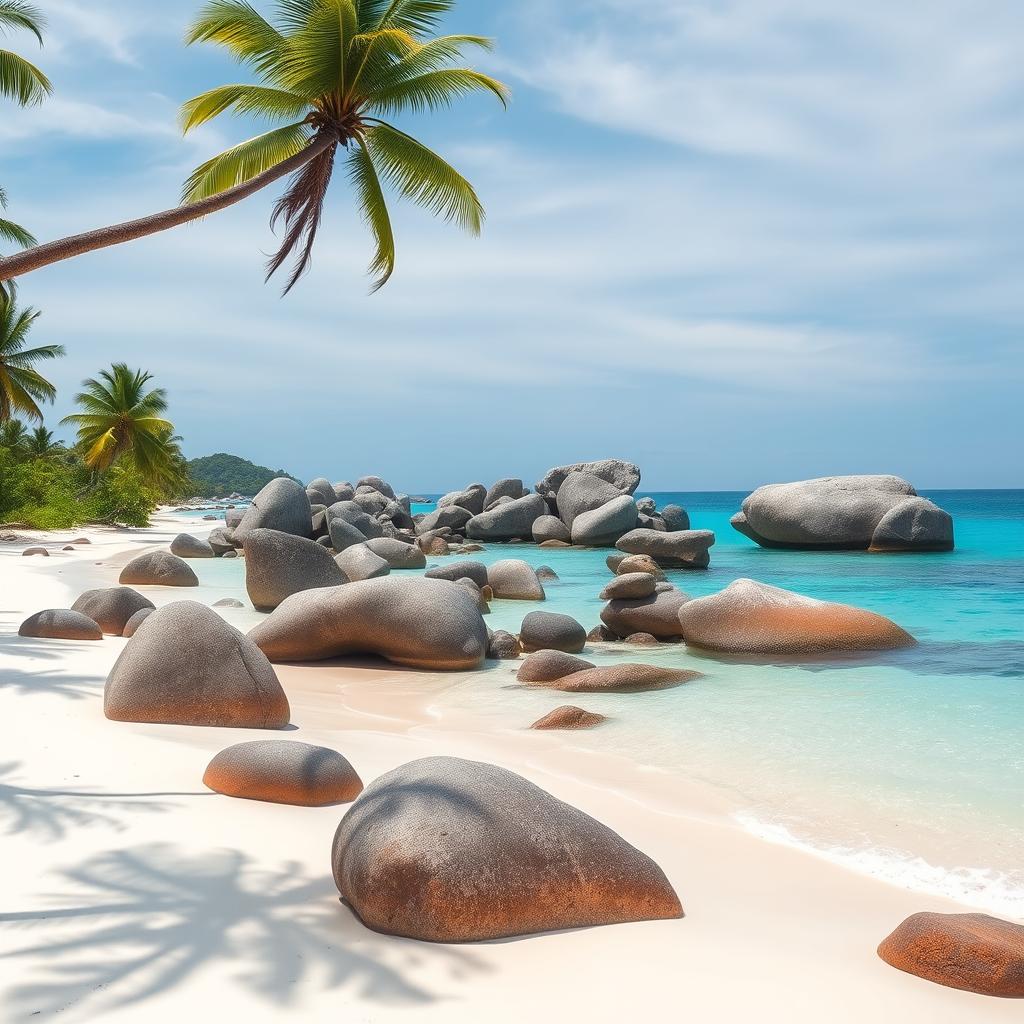
Seychelles
সেশেলস
Important Notice
This content is AI-generated and under editorial review. Visa rules can change at any time. Always verify the latest requirements with the relevant embassy or immigration authority before making travel decisions.
90
days max stay
6 months
passport validity required
Seychellois Creole, English, French
official language
English spoken
SCR
currency
About
The three main islands — Mahé (home to the capital Victoria and ~90% of the population), Praslin, and La Digue — contain virtually all economic activity. The remaining 112 islands are mostly uninhabited coral atolls and nature reserves. Seychelles holds two UNESCO World Heritage Sites: the Vallée de Mai on Praslin (a pristine palm forest home to the coco de mer, the world's largest seed) and Aldabra Atoll (the world's largest raised coral atoll, home to approximately 100,000 giant Aldabra tortoises).
Seychellois society is genuinely multi-ethnic Creole — a blend of African, Indian, Chinese, and European descent with no single dominant ethnicity. This Creole identity is reflected in the country's three official languages: Seychellois Creole (Kreol Seselwa, spoken by virtually everyone), English (used in government, business, and education), and French (used in media and some formal contexts). The multi-ethnic, multilingual character means Seychelles is culturally more welcoming to foreign workers than many homogeneous societies.
Seychelles gained independence from the United Kingdom on 29 June 1976. A 1977 coup established one-party socialist rule under France-Albert René, which lasted until multi-party democracy was restored in the early 1990s. The first opposition presidential victory came in 2020, marking a peaceful democratic transition. The political system is a presidential republic.
The economy is heavily tourism-dependent, with record visitor arrivals in 2025 (13% above pre-pandemic 2019 levels). Fisheries — particularly tuna processing — is the second pillar, contributing approximately 16% of GDP and 90% of domestic exports. A critical fact: Seychelles imports over 90% of its food, making the cost of living significantly higher than mainland destinations. The Seychellois Rupee (SCR) is the national currency.
Last updated: 2026-05-29
Entry & Visa Requirements
- Visa-Free
- IMPORTANT — eTA REQUIRED BEFORE TRAVEL: Seychelles is technically visa-free (no visa stamp is issued), but a mandatory Electronic Travel Authorization (eTA) at EUR 10.90 must be obtained via seychelles.govtas.com BEFORE departure. Apply within 30 days of your travel date. Processing takes approximately 9 hours. DO NOT travel without the eTA — you will be denied boarding. The eTA can also be obtained via the Seychelles e-Border mobile app.
Requirements for eTA approval: valid passport covering your entire stay, confirmed return or onward ticket, proof of accommodation in Seychelles, minimum USD 150 in available funds, and health insurance with minimum USD 50,000 coverage including repatriation. A passport-sized photo is required for the application. The eTA grants entry for up to 3 months, extendable to a maximum of 12 months total stay in any calendar year.
Upon arrival, immigration issues a visitor permit based on the approved eTA. There is no additional fee at the border. Seychelles applies this system uniformly to ALL nationalities — there are no nationality-based visa categories.
For work permits, Seychelles uses the Gainful Occupation Permit (GOP), which is an employer-led, two-step process involving two separate government agencies:
Step 1 — Ministry of Employment and Social Affairs (employment.gov.sc): The employer applies for approval and a Certificate of Entitlement (COE). For most positions, the employer must first advertise the vacancy locally for 3 days to demonstrate no qualified Seychellois applicant is available. However, sectors with a COE allocation — construction, tourism, fisheries, and manufacturing — can recruit foreign workers within their assigned quota WITHOUT prior local advertising. Quotas allow up to 70-75% foreign workers for large companies in labor-intensive sectors.
Step 2 — Department of Immigration and Civil Status (ICS, ics.gov.sc): With the Ministry's approval certificate, the employer submits the GOP application to Immigration. Processing fee: SCR 1,000 (~$70). Monthly permit fee: SCR 500-700/month, paid upfront for the desired duration. Processing takes 1-5 business days if documentation is complete.
The GOP has no fixed maximum duration — the employer pays upfront for however many months are needed, and the permit can be renewed. Certain positions are restricted from the COE quota system and require individual labor market testing: CEO, HR director, sales assistants, cleaners, and drivers.
Required documents: valid passport, signed employment contract, CV with academic certificates, police clearance certificate, medical certificate (including HIV test), passport photos, and professional licences where applicable. The employer must provide company registration, COE allocation letter (if applicable), and proof of local advertising (if not under COE).
A critical difference from mainland African countries: the GOP fee structure (SCR 500-700/month, ~$35-48/month) is ongoing, unlike Kenya's annual lump sum or Rwanda's one-time fee. Over a 12-month contract, GOP fees total approximately SCR 6,000-8,400 (~$410-570). The employer typically covers these costs. Sources: ICS.gov.sc, Fragomen, Playroll, Seychelles Consulate. - Return ticket required
- Proof of funds required
Work Permit Pathway
Step 1 — Ministry of Employment and Social Affairs (employment.gov.sc): The employer initiates the process by applying for a Certificate of Entitlement (COE) allocation or individual approval. The Ministry maintains a jobseeker database and verifies that the position cannot be filled locally. For sectors with COE allocations — construction, tourism/hospitality, fisheries, and manufacturing — employers receive a quota of foreign worker positions and can recruit within that quota without advertising each individual vacancy. This is a significant advantage: resort groups like Constance, Kempinski, and Hilton, and major employers like Indian Ocean Tuna Ltd (IOT) operate under COE quotas, streamlining foreign recruitment.
Step 2 — Department of Immigration and Civil Status (ICS, ics.gov.sc): With the Ministry's approval, the employer submits the GOP application to Immigration. Required documents include: passport, employment contract, CV, academic certificates, police clearance, medical certificate (including HIV test), and passport photos. Processing: 1-5 business days. Fees: SCR 1,000 processing fee (~$70) plus SCR 500-700/month permit fee paid upfront.
The GOP is tied to a specific employer and specific role. If you change employers, a new GOP application is required. Under the 2021 revised framework, workers facing redundancy can no longer change employers within Seychelles — they must leave and re-enter with a new GOP from a new employer. This is a restrictive rule workers should be aware of.
Social security: Both employer and employee contribute to the Seychelles Pension Fund (SPF). Employer contribution: 3% of gross salary. Employee contribution: deducted at source. Foreign workers are eligible for pension contributions to be refunded upon permanent departure from Seychelles, subject to application.
Key practical note: the GOP must be issued BEFORE the worker arrives. You cannot enter on a visitor permit and convert to a work permit without leaving and re-entering. If you arrive in Seychelles before the GOP is issued, you may be denied the right to work. Sources: ICS.gov.sc, Fragomen, Employment Act 1995, Playroll.
Last updated: 2026-05-29
Overstay Penalties & Consequences
Primary penalty: deportation. Any person who remains in Seychelles after the expiry of their visitor permit, GOP, or other authorization is liable to deportation. Upon receiving a deportation order, you have a 7-day appeal window to contest the decision. If the appeal fails or is not filed, removal proceeds.
Financial recovery: A judge may issue a warrant for levy by distress and sale of property belonging to the prohibited immigrant to recover government expenses for detention, maintenance, medical treatment, or deportation. This means the government can seize your belongings to cover the costs of removing you.
Related penalties under the Immigration Decree: carrying or assisting a prohibited immigrant (by vessel or aircraft) carries a fine of SCR 20,000 (~$1,360). Failure to surrender your passport to an immigration officer when requested carries a fine of SCR 30,000 (~$2,040) and up to 3 years imprisonment. These are serious penalties relative to local income levels.
For GOP holders whose contract ends: your right to remain in Seychelles terminates when your GOP expires. You must depart within the timeframe specified. Under the 2021 revised GOP framework, workers facing redundancy cannot transfer to a new employer within Seychelles — they must leave the country. Failure to depart after contract completion is treated as overstay and leads to deportation proceedings.
Practical advice: Seychelles is geographically isolated — you cannot simply cross a land border. Deportation means a flight, which is expensive and disruptive. Maintain your documentation diligently. Set reminders 30 days before your permit expires. If your employer is handling renewal, confirm the timeline in writing. If you discover your permit has lapsed, contact the Department of Immigration (ICS) immediately — voluntary disclosure typically receives more considerate treatment than being discovered during a check. Sources: SeyLII Immigration Decree Cap 93, MFA.gov.sc, OHCHR Migrant Workers Committee on Seychelles 2015.
Job Market
Tourism — the economic engine:
Tourism is Seychelles' primary economic driver, with record visitor arrivals in 2025 (13% above pre-pandemic 2019 levels). Major international resort groups actively hire foreign workers for kitchen staff, housekeeping, waitstaff, spa therapists, front office, and maintenance roles. Verified employers currently hiring: Constance Hotels (Mauritian group, two Seychelles properties — Ephelia on Mahé and Lemuria on Praslin, currently advertising Night Auditor, F&B Manager, Guest Service Agent, Spa Manager positions), Kempinski Seychelles Resort (Baie Lazare, Mahé — hiring Steward, Butcher, Commis, Demi Chef de Partie, Front Office via JOBO.sc), Hilton Seychelles (Labriz Resort and Northolme Resort on Mahé), Four Seasons Resort Seychelles, and Six Senses Zil Pasyon on Félicité Island.
Tuna and fisheries — the second pillar:
Indian Ocean Tuna Ltd (IOT), a subsidiary of Thailand's Thai Union Group, is one of the world's largest tuna canneries and a major employer. IOT employs approximately 2,000+ people, with 68% being foreign workers and 32% Seychellois (Seychelles News Agency). Foreign workers fill processing, canning, and manual labor roles. Fisheries contributes approximately 16% of GDP, employs ~12% of the population, and generates 90% of domestic exports. Seychelles listed in S&P Global Sustainability Yearbook 2024 partly due to IOT's sustainable tuna practices.
Construction — largest foreign worker sector:
Construction accounts for 38.6% of all foreign labor in Seychelles. Major government housing programs drive demand: Saudi Fund for Development committed $15M for 172 social housing units (2024-2026), Abu Dhabi Fund contributed $8.7M for social housing (2026). High demand for bricklayers, carpenters, crane operators, painters, welders, and general construction workers. The Certificate of Entitlement (COE) quota system allows construction companies to recruit foreign workers without individual labor market testing.
Top foreign worker nationalities: India 50.7%, Malaysia 6.2%, Philippines 5.5%, Sri Lanka 4.6%. Bangladesh is explicitly listed among top Asian source countries (IOM 2024).
Sectors with limited foreign worker access: government/civil service (mostly reserved for Seychellois), and certain restricted positions (CEO, HR director, sales assistants, cleaners, drivers) are excluded from the COE quota system.
Last updated: 2026-05-29
Salary & Payments
| Sector | Min | Max | Currency |
|---|---|---|---|
| 0 | 0 | SCR/mo | |
| 0 | 0 | SCR/mo | |
| 0 | 0 | SCR/mo | |
| 0 | 0 | SCR/mo | |
| 0 | 0 | SCR/mo | |
| 0 | 0 | SCR/mo | |
| 0 | 0 | SCR/mo | |
| 0 | 0 | SCR/mo |
The average national salary is approximately SCR 15,000-19,700 per month (~$1,020-1,340), though this varies dramatically by sector. Tourism/hospitality wages are genuinely liveable: a kitchen helper starts at ~$410/month, while experienced cooks earn $680-1,230/month (Paylab Seychelles). Construction wages are the strongest in the foreign worker market: general workers $505-1,425/month, skilled trades like welders up to $1,813/month. These are dramatically higher than comparable roles in Kenya ($120-345/month) or Rwanda ($70-240/month).
However, the critical caveat: Seychelles is extremely expensive. The minimum wage of $422/month sounds generous until you consider that a local restaurant meal costs $17, eggs cost $3.67/dozen, and 1BR rent is $760-900/month. Real purchasing power — what your salary actually buys — is moderate despite the high nominal figures. A construction worker earning $800/month in Seychelles may have similar or less disposable income after expenses than one earning $250/month in Rwanda.
The saving grace: employer-provided housing is common in hospitality and construction, particularly at major resort groups and IOT. If your employer provides accommodation and meals, your effective savings rate improves dramatically. Before accepting any offer, confirm in writing: base salary in SCR, whether housing is provided or an allowance given, meal provisions, and whether GOP fees are employer-paid.
Salary data source quality: Paylab.com provides role-specific Seychelles data with reasonable sample sizes for tourism and construction. Minimum wage is government-gazetted and reliable. Tuna processing wages are estimated from minimum wage floor — IOT does not publish salary bands publicly. Exchange rate: ~14.7 SCR per 1 USD (fluctuates). Sources: Paylab.com/sc, WageIndicator, Seychelles News Agency, Rivermate.
Last updated: 2026-05-29
Where to Apply
Ministry of Employment and Social Affairs
Official PortalDepartment of Immigration and Civil Status (ICS)
Official PortalSeychelles Investment Board (SIB)
Official PortalSeychelles Revenue Commission (SRC)
Official PortalIndian Ocean Tuna Ltd (IOT)
Major EmployerConstance Hotels (Ephelia + Lemuria)
Major EmployerKempinski Seychelles Resort
Major EmployerHilton Seychelles (Labriz + Northolme)
Major EmployerFour Seasons Resort Seychelles
Major EmployerSeychelles Breweries (SeyBrew)
Major EmployerLast updated: 2026-05-29
Housing & Living
Housing (Victoria / Mahé):
1-bedroom city centre: ~SCR 13,172 ($896/month). 1-bedroom outside city: ~SCR 11,167 ($759/month). Shared room for foreign workers: estimated $300-500/month depending on location. CRITICAL: employer-provided housing is common in hospitality (resort staff quarters) and construction (site accommodation). If your employer provides housing, this dramatically changes your cost structure. Before accepting any offer, confirm whether accommodation is included.
Food:
Inexpensive restaurant meal: SCR 250 (~$17) — substantially more expensive than Kenya ($5.77) or Rwanda ($1.90-3.10). Mid-range 2-person dinner: SCR 700 (~$48). Rice 1kg: SCR 36.25 ($2.47). Eggs dozen: SCR 54 ($3.67). Chicken 1kg: SCR 86.25 ($5.87). Bread 500g: SCR 24.21 ($1.65). Cooking at home is significantly cheaper but still expensive by South Asian standards. Local fish is the most affordable protein (Seychelles is surrounded by ocean) — buy from fishermen at the Victoria market.
Transport:
Public bus (SPTC): SCR 11-12 ($0.79) per ride — extremely affordable and covers most of Mahé. Monthly pass: SCR 463 ($31.50). The bus network operates from ~5:30am to ~7:30pm. No buses between islands. Inter-island ferry Mahé to Praslin: ~EUR 50-70 one-way ($55-77). Ferry Praslin to La Digue: ~EUR 15 ($16.50). Domestic flights exist but are expensive. Most foreign workers live and work on Mahé and rarely travel between islands.
Mobile & Internet:
Two providers: Cable & Wireless Seychelles and Airtel Seychelles. Prepaid SIM: ~SCR 149-271 for 1-5 GB data packages. Monthly mobile plan: ~SCR 587 ($40). Broadband internet: SCR 2,033 ($138/month) for 60+ Mbps — expensive. Wi-Fi is available at most employer-provided accommodations.
Total Monthly Estimate:
With 1BR outside centre (no employer housing): $1,200-1,500/month including rent, food, transport. With employer-provided housing and meals (common in resorts): $300-500/month personal expenses only. The employer housing factor is THE deciding variable for Seychelles affordability.
Currency: Seychellois Rupee (SCR). Exchange rate: ~14.7 SCR = $1 USD (2026). Credit/debit cards widely accepted in Victoria and tourist areas. Mobile money less developed than East African countries. Sources: Numbeo Victoria May 2026, Seychelles Ferry, Airtel Seychelles.
Social & Culture
South Asian Worker Network:
The Indian community is the largest foreign worker group in Seychelles, providing a practical support infrastructure that Bangladeshi workers can access: shared language familiarity (Hindi/Urdu understood by many BD workers), South Asian grocery supplies, and cultural reference points. Sri Lankan workers are also present (4.6% of foreign workers). This South Asian ecosystem means you are not arriving into a cultural vacuum — there are people who understand your food, your languages, and your cultural norms.
Muslim Community:
Seychelles has approximately 1,459 Muslims (1.6% of the 2010 census population, likely higher now). Three mosques serve the community on Mahé: Victoria Mosque (seats 800, in the capital), Mont Fleuri Mosque (seats 750, opened 2013, also in Victoria), and Pointe Au Sel Mosque (southern Mahé, daily prayers and Jumu'ah). Friday prayers are accessible. Ramadan is observed by the community. The Muslim presence is small but organized and welcoming. Sources: US State Department, Wikipedia Islam in Seychelles.
Halal Food:
Halal food is available in Seychelles, primarily through Indian restaurants that serve halal cuisine with South Asian flavours familiar to Bangladeshi palates. Some fast-food establishments serve halal burgers and wraps. Several hotels offer halal-friendly dining options for Muslim guests. Fresh fish — the staple protein in Seychelles — is inherently halal and extremely affordable at the Victoria fish market. Rice, lentils, and vegetables are readily available. Outside Victoria and the resort areas, halal options become limited — plan accordingly. Source: HalalBooking.
Climate:
Seychelles has a tropical climate that Bangladeshi workers will find very familiar: temperatures 26-28°C year-round, humidity 75-83%. This is similar to Bangladesh's climate but with less extreme variation — no scorching summers and no true cold season. Trade winds from June to September bring drier, cooler conditions. Seychelles is too close to the equator for cyclones, making it safer than many tropical destinations. Rainfall is moderate and distributed throughout the year. You will not need to adjust to a dramatically different climate — unlike the highland coolness of Kigali or the seasonal extremes of Nairobi.
Language:
Seychellois Creole (Kreol Seselwa) is the daily spoken language, but English is an official language used in government, business, education, and tourism. In the hospitality sector, English is the working language. French is also official and used in media. Most Seychellois are trilingual. For a Bangladeshi worker with basic English, communication is significantly easier than in Francophone Africa or the Middle East.
Creole Culture Context:
Seychellois Creole culture is inherently multi-ethnic — a blend of African, Indian, Chinese, and European heritage. This mixed-origin society means there is no dominant ethnic identity and foreigners are not seen as outsiders in the way they might be in ethnically homogeneous countries. Indian cultural influence is already embedded in Seychellois food, festivals, and social customs. A South Asian worker will find cultural touchpoints that simply don't exist in East African countries.
Honest Assessment:
Seychelles offers the best cultural environment for Bangladeshi workers among the African countries in this enrichment set. You will find a documented BD worker presence, a functioning South Asian community network (Indian-led), accessible mosques and halal food, a familiar tropical climate, and a society that is culturally receptive to diversity. The trade-off: the cost of living is very high, and the country is geographically isolated (no land borders, flights are expensive). Sources: IOM Migration Profile 2024, HalalBooking, ClimatestoTravel.
Business Opportunities
International Business Company (IBC):
Seychelles IBCs allow 100% foreign ownership with minimal requirements: a single shareholder and a single director (both can be foreign, no local residency required). Government registration fee: USD 150 at incorporation and annually. IBCs enjoy zero tax on foreign-sourced income — dividends, interest, and royalties from outside Seychelles are untaxed. The IBC framework is regulated by the Seychelles International Business Authority (SIBA). Recent IBC Amendment Acts of 2020, 2024, and 2025 introduced stricter compliance requirements, enhanced disclosure obligations, and tighter regulatory oversight — Seychelles is actively aligning with OECD transparency standards. France removed Seychelles from its blacklist of non-cooperative tax jurisdictions on 12 May 2025, confirming this alignment. Sources: BBCIncorp, Privacy Solutions.
For Bangladeshi entrepreneurs, a Seychelles IBC is useful as: a holding company for Indian Ocean or African operations, a trading intermediary, an intellectual property holding vehicle, or a forex/investment structure. The key advantage over other offshore jurisdictions is the combination of low cost ($150/year government fee), minimal paperwork, and genuine privacy protections — though the 2024-2025 amendments now require beneficial ownership disclosure to authorities.
Tourism Investment:
The Seychelles Investment Board (SIB, investinseychelles.com) is the first point of contact for foreign tourism investment. Opportunities include boutique hotels, eco-tourism lodges, diving operations, and charter services. The government actively seeks tourism infrastructure investment, particularly on outer islands. However, land ownership is restricted for foreigners (leasehold arrangements typically available, not freehold).
Blue Economy:
Seychelles controls a 1.358 million km2 Exclusive Economic Zone (EEZ) — one of the largest in the Indian Ocean relative to its land area. The Blue Economy Roadmap covers sustainable fishing, aquaculture, marine biotechnology, ocean energy, and seabed mining. The 2023 SDG Investor Map highlights specific opportunities: sustainable aquaculture, semi-industrial fishing, digital fish traceability systems, and fish by-product processing (fish oils, seaweed fertilizer). For Bangladeshi entrepreneurs with fisheries experience, this is a natural sector.
Practical Barriers (honest assessment):
Seychelles' domestic market is tiny: ~130,000 people with limited consumer purchasing power despite high GDP per capita. Operating costs are among the highest in Africa due to island logistics and import dependency. Real estate is expensive and foreign ownership is restricted. The IBC framework is excellent for international business structuring but the domestic economy offers limited opportunity for traditional retail or manufacturing businesses. Seychelles has no free trade zone or manufacturing SEZ comparable to Rwanda's or Kenya's.
BD-Seychelles Corridor:
Bilateral trade between Bangladesh and Seychelles is minimal. The most practical business connection is using a Seychelles IBC as a corporate vehicle for broader Indian Ocean or African operations rather than direct BD-Seychelles trade. Seychelles' membership in COMESA and the Indian Ocean Commission provides some regional market access. Sources: investinseychelles.com, Blue Economy Seychelles, SIBA.
Content Quality
AI Generated — Under ReviewVerify with Embassy
Visa rules change frequently. Always verify the latest entry requirements with the embassy or consulate of your destination country before making travel plans.
View Embassy DirectoryCost of Living
Seychelles is one of the most expensive countries in this enrichment set — comparable to the Maldives. The fundamental driver: Seychelles imports over 90% of its food. Everything from rice to eggs to cooking oil arrives by ship, and the import cost is reflected in retail prices. Housing (Victoria / Mahé): 1-bedroom city centre: ~SCR 13,172 ($896/month). 1-bedroom outside city: ~SCR 11,167 ($759/month). Shared room for foreign workers: estimated $300-500/month depending on location. CRITICAL: employer-provided housing is common in hospitality (resort staff quarters) and construction (site accommodation). If your employer provides housing, this dramatically changes your cost structure. Before accepting any offer, confirm whether accommodation is included. Food: Inexpensive restaurant meal: SCR 250 (~$17) — substantially more expensive than Kenya ($5.77) or Rwanda ($1.90-3.10). Mid-range 2-person dinner: SCR 700 (~$48). Rice 1kg: SCR 36.25 ($2.47). Eggs dozen: SCR 54 ($3.67). Chicken 1kg: SCR 86.25 ($5.87). Bread 500g: SCR 24.21 ($1.65). Cooking at home is significantly cheaper but still expensive by South Asian standards. Local fish is the most affordable protein (Seychelles is surrounded by ocean) — buy from fishermen at the Victoria market. Transport: Public bus (SPTC): SCR 11-12 ($0.79) per ride — extremely affordable and covers most of Mahé. Monthly pass: SCR 463 ($31.50). The bus network operates from ~5:30am to ~7:30pm. No buses between islands. Inter-island ferry Mahé to Praslin: ~EUR 50-70 one-way ($55-77). Ferry Praslin to La Digue: ~EUR 15 ($16.50). Domestic flights exist but are expensive. Most foreign workers live and work on Mahé and rarely travel between islands. Mobile & Internet: Two providers: Cable & Wireless Seychelles and Airtel Seychelles. Prepaid SIM: ~SCR 149-271 for 1-5 GB data packages. Monthly mobile plan: ~SCR 587 ($40). Broadband internet: SCR 2,033 ($138/month) for 60+ Mbps — expensive. Wi-Fi is available at most employer-provided accommodations. Total Monthly Estimate: With 1BR outside centre (no employer housing): $1,200-1,500/month including rent, food, transport. With employer-provided housing and meals (common in resorts): $300-500/month personal expenses only. The employer housing factor is THE deciding variable for Seychelles affordability. Currency: Seychellois Rupee (SCR). Exchange rate: ~14.7 SCR = $1 USD (2026). Credit/debit cards widely accepted in Victoria and tourist areas. Mobile money less developed than East African countries. Sources: Numbeo Victoria May 2026, Seychelles Ferry, Airtel Seychelles.
Free Tools to Help You Apply
Apply directly to overseas employers.
All tools are free. Cover letter and contract checker require a free account.
Before You Travel
Visa-free entry is just the first step. Real preparation matters.
- • Passport validity (6+ months beyond travel date)
- • Return/onward ticket booking
- • Proof of funds documentation
- • Currency exchange arrangement
- • Vaccinations (per destination requirements)
- • Emergency contacts (embassy, family)
Sponsored Agencies
GermanJobs BD
Specialist in German work visas
View profile →Iberia Talent Bridge
IT and hospitality bridge to Iberia
View profile →NEW STAR RECRUITING AGENCY
Mk Nasir uddin
View profile →Italia Manpower
Your bridge to Italian employment
View profile →Sponsored content. Verify agencies with BMET before any payment.
Last verified
29 May 2026
Visa rules may change — always verify before travel.


